
What do you see?
Sunshine (2007).

This May, we’re going to space! Our first theme month, Schlubs In Space, was chosen by our lovely followers on Instagram. If you’d like to vote on future themes, get updated release schedules, or see what we else have in store, please follow us on Instagram.
Warning: this essay contains mild spoilers for Sunshine.
Despite not having had a theatrical feature in six years, the Star Trek franchise is in the midst of a new renaissance – as popular series such as Discovery, Picard, and Strange New Worlds keep Paramount+ in the streaming wars. However, there is a divide among Trekkies over the direction of the long-running space saga. On one hand, should the franchise follow in the footsteps of J.J. Abrams’ bombastic rebooted trilogy? Or should it return to its quieter roots – where levelheaded discussion and mental gymnastics reigned supreme?1
Watching Danny Boyle’s Sunshine reminds us that these approaches don’t have to be separate. Sunshine, a 2007 thriller where a diverse crew of astronauts must restart our dying Sun, manages to combine breathtaking action sequences with clinical scientific debates – all while maintaining an intimate focus on its cast of sweat-drenched spacemen.
Over these last two weeks of Schlubs in Space, it’s become clear that ensembles are ideal for deep space cinema. Not only do you have the opportunity to build an interesting and specialized cast, but you then put them in a pressure cooker for months (if not years) on end. It’s like a submarine – but with a somehow more oppressive force bearing down upon its hull. That pressure constricts from the start – as physicist Robert Capa (Cillian Murphy) wearily explains in the opening monologue that they are not the first attempt to restart the dying Sun.2 But they are the final one.
Inspired by the joint missions of the International Space Station, the Icarus II is populated with a cast of heavy-hitters from across the globe. From legends of Hong Kong action cinema (Michelle Yeoh) to the hardest working Kiwi character actor in the business (Cliff Curtis), these are some of the best actors of a generation, and they’re able to establish gravitas the minute they appear on screen. Thanks in part to writer Alex Garland’s excellent script, Sunshine is filled with thrilling scenes of our scientists arguing their hypotheses and debating moral quandaries. Sure, the idea of restarting the Sun may be ludicrous, but the film respects itself and the audience enough to take the concept seriously. These scenes are like watching a professor explain their mathematical proofs. This may sound boring, but when an error of less than one percentage point could doom humanity to a slow and cold death, the calculations are edge of your seat material.
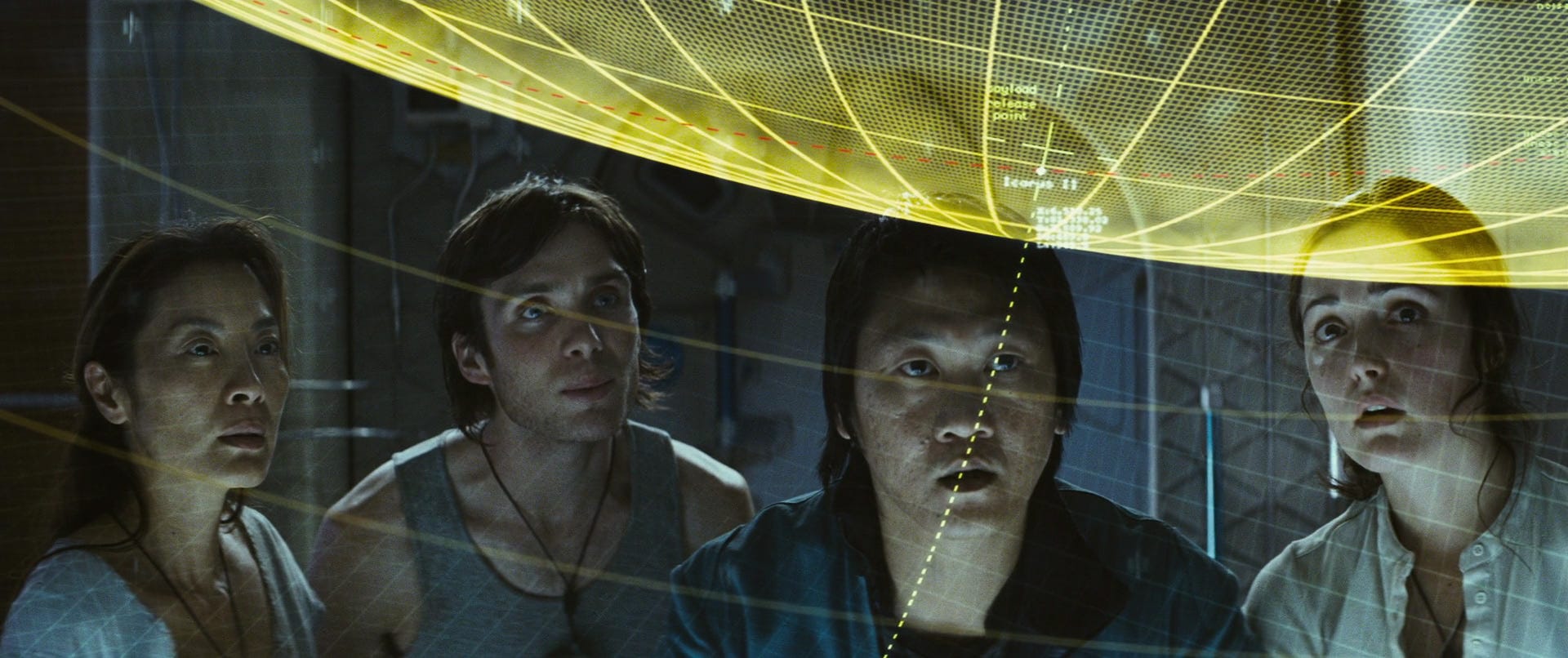
After watching the film, my girlfriend and I had an argument about whether or not this qualified as Schlub Cinema. These people are determined, experts in their field, and generally much more emotionally stable than most of the schmucks I cover here. It’s true – but the subversion of tropes and minute specifics that Boyle and Garland layer onto each character pull it over the line for me. For example, chief engineer Mace (Chris Evans) seems to fill the role of antagonist early on – he’s bitter, overly-macho, and even assaults Robert within the opening minutes. However, when our crew becomes sidetracked with the possibility of investigating the disappearance of Icarus I, Mace is the only one to immediately say “no.” He acknowledges the possibility that their sister crewmembers could still be alive – but compared to the scale of not completing their mission? Of course it’s a no.
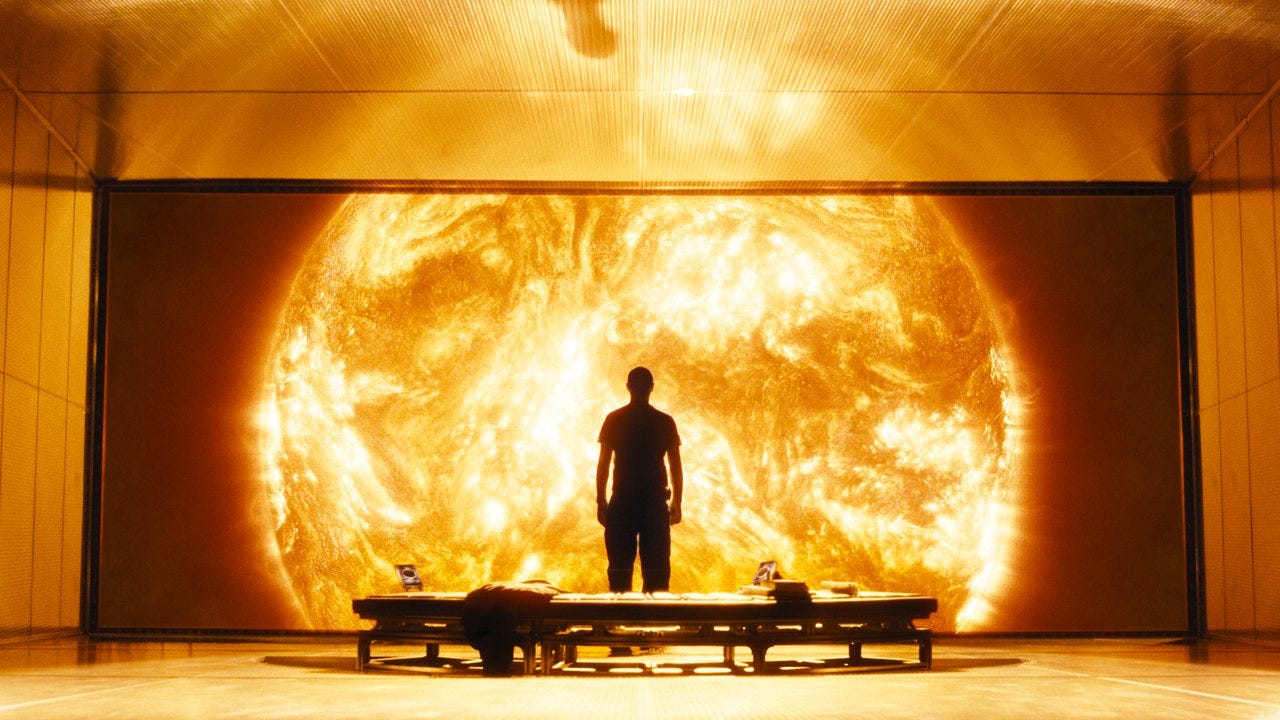
That scale is where Danny Boyle’s directing truly shines. Not only do the small-scale emotional stakes matter, but they’re complimented by the awe-inspiring scope of space. Utilizing both a Tony Scott level of gonzo camera-work and a Kubrickian steady hand, Boyle frames the Sun as both God and Leviathan. A pale white whale lurking outside the hulls of the ship and a celestial being that one's eyes cannot be peeled away from. Searle (Cliff Curtis), the doctor and psychologist aboard Icarus II, spends his days inside the observation room – where you can view the Sun through a powerful dimmer. Gradually turning the dimmer lower and lower, his body molts with dead skin and cracked burns over the course of their journey. Still he watches. In a nail-biting set piece, where one crewmember is about to be incinerated by the full power of the Sun, Searle radios them desperately, “What do you see?” he begs.
“What do you see?”
Boyle is no slouch when it comes to horror, having directed one of the most influential zombie movies of all time with 28 Days Later. Yet, here he’s tapped into a fear more primal than the undead. In Sunshine, the giver of all life is the enemy. The religious aspects of this terror aren’t lost on the film (it takes center stage in the controversial third act), but they interweave in a way that I find particularly interesting. The intersection of religion and technology is a well trodden idea in fiction, but when done right, it carries a creeping dread that nothing can compare to.3 Golden rays of light are always present, reflecting from the radiant solar panels past the cool blue interior of the ship. Video of the heavens from Icarus II’s exterior cameras are ripped and scratched by solar radiation.4 The immense solar shield of Icarus II blazes like the flaming wheels of Ezekiel's vision.
Late in the film, a crewmember posits that restarting the Sun could be the ultimate act of hubris. A worse movie could give into that argument – that humanity is not worth the cost. But as Sunshine posits the Sun as a monster, it never forgets its role as the giver of life. There is a sense of hope so firmly embedded in this film. Whether this is from the operatic score, or by watching the joy of discovery flirt across our scientists faces as they pass Mercury,5 it reassures us that humanity is worth saving.
Sunshine is available to rent on Amazon Prime or iTunes.
Special thanks to Austin Smoldt-Sáenz, Elena Bruess, Joshua De Lanoit, and Max Seifert.
To be fair – I’m a Trek neophyte. I’ve only seen two of the films (Wrath of Khan and the '09 reboot), but in the early days of the pandemic I began watching The Next Generation to remedy my insomnia. Although Ken Burns’ Baseball would eventually take the title for “most sleepy show.”
The first mission, Icarus I, lost contact with Earth before it could complete its objective.
Some notable examples of this are Neon Genesis Evangelion and Alex Garland’s own (and somewhat uneven) series Devs.
There is nothing more effectively unnerving or visually interesting as showing a little monitor with grainy VHS-quality footage. It’s like a cheat code to immediately gain my attention.
Watching scientists get giddy is a great way to establish stakes. It’s like those videos from undersea submarine expeditions discovering a new species. Sure, it may just look like another pale fish – but listening to the scientists off camera losing their minds in excitement reminds us how important that pale little fish is.